County presentation provides opportunity for context and raises key questions about Tucker’s long-term policing options.
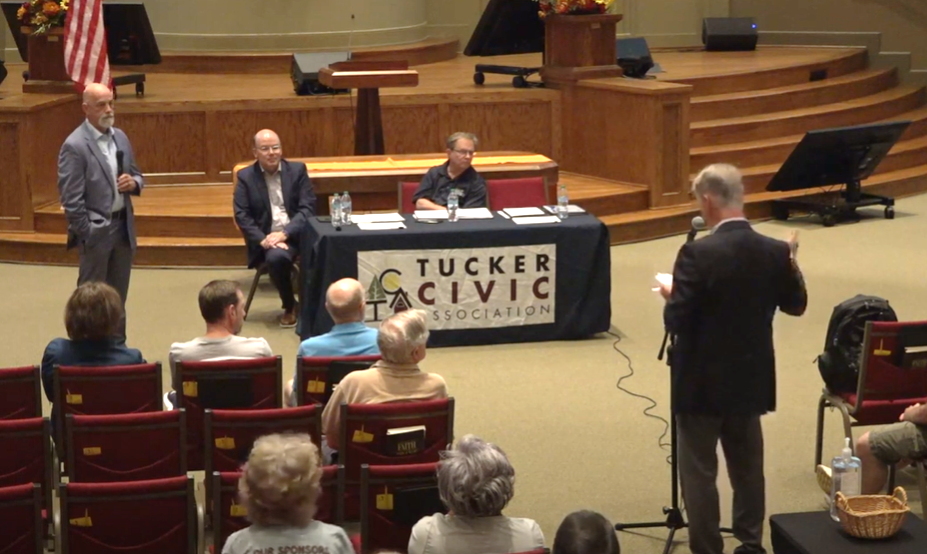
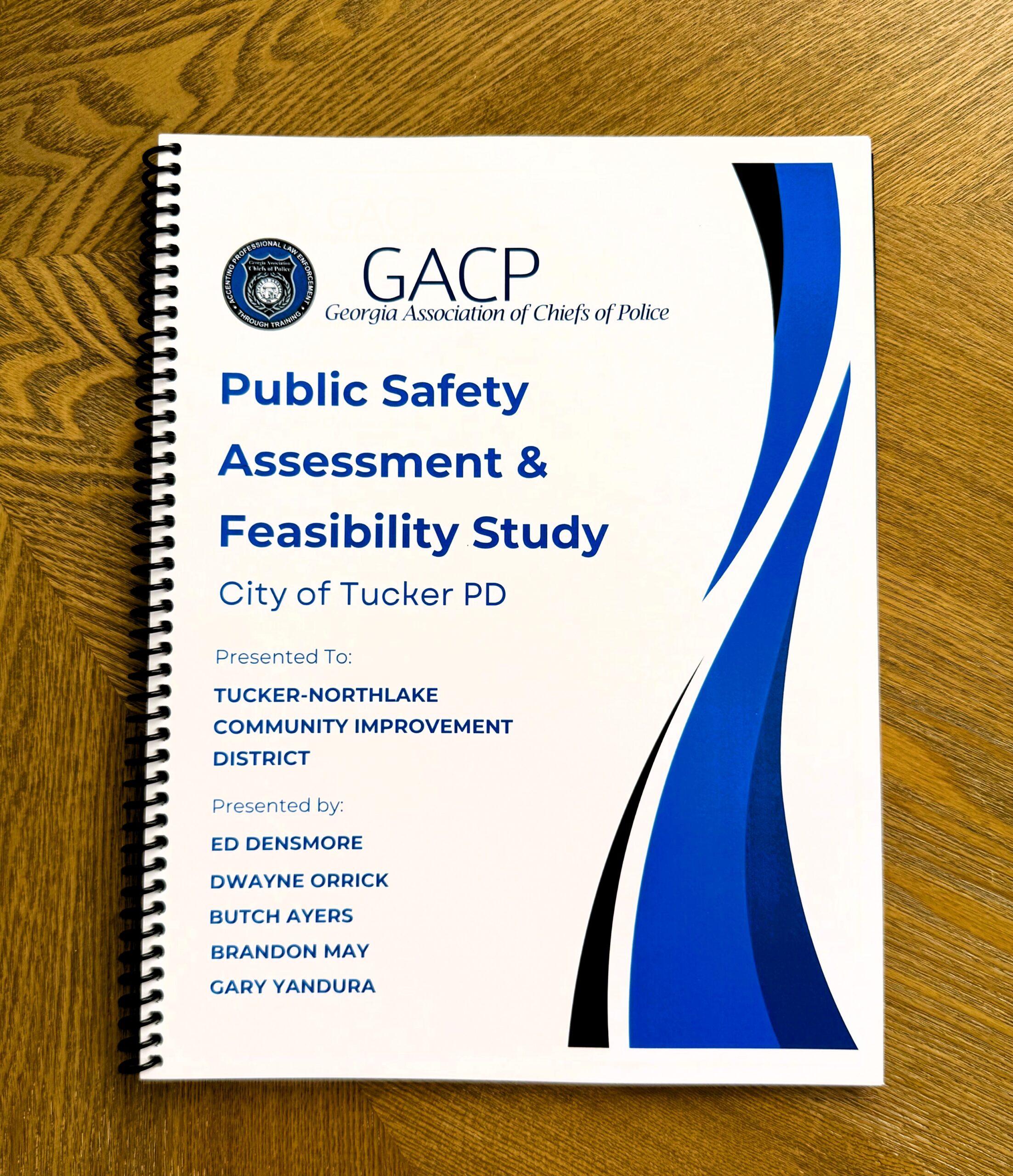
On November 20, 2025, DeKalb County CEO Lorraine Cochran-Johnson, Chief Operating Officer Zach Williams, and Interim DeKalb County Police Chief Greg Padrick presented an update on changes made to police and 911 operations since CEO Cochran-Johnson took office in January. The public meeting—attended by Tucker Mayor Frank Auman, four members of the City Council, city and county staff, and Tucker residents—also served as the County’s response to the Tucker Public Safety Assessment and Feasibility Study conducted by the Georgia Association of Chiefs of Police.
This response followed a meeting between CID, County, and City leaders, held five weeks before the study was publicly released, where County leadership and Mayor Auman expressed interest in the findings but raised concerns that some of the study’s 2023 and 2024 data might be outdated and that certain costs may not have been examined in sufficient depth. At that time, the County offered to review the study more thoroughly and provide a formal response.
The Tucker Civic Association hosted the Tucker-Northlake CID’s presentation on the feasibility study in September, and extended the same opportunity to DeKalb County, ensuring residents could hear both perspectives.
The DeKalb County Police Department is making significant progress under the leadership of CEO Lorraine Cochran-Johnson, and that progress is expected to continue. At the same time, the CID stands by the results of the Public Safety Assessment and Feasibility Study conducted by the Georgia Association of Chiefs of Police.
The study was never intended to provide a side-by-side comparison of every possible service a city police department could offer, but rather to assess what matters most: improving response times, deterring crime, and ensuring patrol officers remain within the city limits.
This overview helps clarify the County’s remarks, correct key misunderstandings from the meeting, and outlines how the study informs Tucker’s potential policing options.
Special Services
The Georgia Association of Chiefs of Police determined that decisions on what special services should be brought in-house, versus those that operate through multi-jurisdictional agreements, should be determined by Tucker’s chief of police and the City Council, rather than the study.
Last year, DeKalb County collected approximately $15.9 million in property taxes for police services in Tucker. This is more than what Brookhaven and Dunwoody have budgeted for police in their cities, and both have larger populations than Tucker. This indicates Tucker contributes enough to support multiple service models, far beyond the $10.7 million estimated in the Feasibility Study. The question is not whether funding exists, but how the City may choose to allocate it.
For example, while the City could choose to have its own SWAT team, it could also follow the model of North Metro SWAT, a successful five-city partnership where each city provides resources to support cross-jurisdictional operations. This reduces the cost burden and ensures that when the need is present, a SWAT team can be deployed. Models like these demonstrate that specialized services do not always need to be duplicated at the city level to be effective.
Collected by DeKalb County for Police Services in 2024: $15.9 million
Estimated base cost for year one: $10.7 million
Funding available for tailoring special services to Tucker’s needs: $5.2 million
Tucker will need to determine if it needs a K-9 unit, but that would likely not be in year one. Likewise, while DeKalb has a helicopter, the County presentation acknowledged the benefits in speed, safety, and cost savings of using drones rather than a helicopter. Similarly, while having a bomb disposal and investigation unit is helpful, it’s more likely that Tucker would want a traffic safety unit. These examples illustrate a range of choices and how communities can prioritize services based on their specific needs.
The feasibility study intentionally did not enumerate these additional costs, and with approximately $5 million available beyond the estimated base cost for year one, the City would have flexibility to determine which specialized services, partnerships, or technologies are most appropriate, and when they should be implemented.
Cameras and Drones
The Tucker community will likely want greater policing on the emerging trail network and a robust camera network on streets. In 2024, the estimate to place license plate readers at every entrance and exit to Tucker was between $132,000 and $183,000 annually.
That cost could be lower depending on the vendor, whether cameras are owned or leased, and on potential partnerships with Clarkston, Gwinnett, and Stone Mountain. Independent of the police services budget collected by DeKalb County, Tucker is already working to integrate cameras into streetlights in Downtown Tucker.
DeKalb County is upgrading technology through an agreement with Flock Safety for “Digital Shield,” a ten-year, $18.9 million countywide agreement that includes several hundred new cameras and four drones. This represents progress, but these resources will be deployed across the entire County. Tucker represents 7% of the population and 9% of the land area, meaning the majority of these assets will serve other areas. The scale of DeKalb’s jurisdiction naturally affects how and where these assets can be prioritized.
For drone technology, Brookhaven is a well-established national leader. Captain Abrem Ayana has built an outstanding reputation for Brookhaven’s drone program. Industry leaders come to him rather than the other way around. In 2024, Brookhaven’s drones were the first responder on the scene for 72% of calls, and the average time from deployment to arrival was 70 seconds. They currently have eight drones for 911 response and publish all drone flight paths online for public access. Brookhaven currently allocates $450,000 annually for drone operations.
An agile approach like Brookhaven’s demonstrates what is possible when a department tailors technology to local priorities and scale. As stated previously, the level of tax revenue Tucker contributes to county police services suggests that a similar-sized program could be achievable if the City were to pursue one, depending on its future decisions about service delivery.
Police Facility Options
While the study did discuss a police facility and considerations including insurance, the County pointed out that the study did not include the cost of a facility or the $1,200 in monthly janitorial costs for the current Tucker Precinct building on Lawrenceville Hwy. The County estimates that the property and facility are worth $2.8 to $3 million.
Due to a variety of options in real estate, questions about where city hall will eventually be located, and whether Tucker would decide to lease an existing space or build a new facility, the study concluded that facility planning involves too many variables to estimate responsibly at this stage. As a result, it was deemed appropriate to leave this entire decision to the City.
For example, the land for the DeKalb County Police Tucker Precinct was donated as a gift, from the Cofer family in 1998, for the express purpose of building a police precinct in Tucker. Typically, when a city takes on a county service, land assets used for that service are transferred to the city rather than being sold for profit. These properties and the facilities on them have already been paid for by taxpayers. When the City took on parks and recreation in 2018, Tucker obtained county parks for hundreds of dollars per acre, not thousands. This precedent illustrates how asset transfers have historically been handled between DeKalb County and the City.
Should Tucker create a city police department, it would be unusual for the County to keep the Tucker Precinct building when it is located in the heart of the City and over a mile from any unincorporated areas. However, any decision would ultimately depend on intergovernmental negotiations, as asset transfers are not automatic and would need to be mutually agreed upon.
Another important question is timing. If Tucker were to invest in a facility in another location, when would it happen? Dunwoody purchased an existing building for its city hall and police department for $8 million in 2016. This was seven years after incorporation. Brookhaven purchased land to build a new police facility in 2018, five years after starting a police department.
Location, design, and long-term strategy all play an important role in costs; thus, for several reasons, the study advised that decisions regarding timing and investment be deferred until the City has clarity on long-term needs and service models.
Vehicles
The County presentation stated that the Tucker Feasibility Study does not include vehicle costs, but the study does include them, using an estimate of $71,000 per vehicle (compared to the County’s $68,000). Both the study and DeKalb support take-home vehicles, which extend vehicle life, improve responsiveness, and reduce mileage and wear on officers’ personal vehicles.
Staffing and Benefit Comparisons
The Tucker Feasibility Study recommended a staff of 53 sworn officers and 10 non-sworn/civilian employees. The County compared this to the 79 sworn officers and 4 non-sworn employees currently assigned to the Tucker Precinct. However, those 79 officers are responsible for responding to calls in a 40-square-mile area with a population of over 100,000. The recommendation in the Tucker Feasibility Study is to keep all 53 sworn officers within the City of Tucker, an area half the size of the DeKalb County Tucker Precinct, serving a population of approximately 38,000 residents. In other words, the study reflects a different service model—one focused solely on Tucker—rather than attempting to match the structure of the existing precinct.
The County found that their overall benefits package was 6% more than the estimate in the Tucker Feasibility Study. This difference reflects the assumptions each side used when projecting long-term personnel costs, and it is not unusual for benefit estimates to vary at this stage of analysis.
Some have assumed a Tucker Police Department would pull largely from DeKalb for officers. New departments typically hire from multiple sources, and the chief of police would be expected to build a team aligned with Tucker’s specific service expectations and organizational culture.
What is certain is that all the police department employees currently working to serve Tucker would be realigned to serve unincorporated DeKalb. This reallocation would increase staffing levels and improve officer-to-resident ratios in the County. It is not expected that officers well-established in DeKalb’s pension program would leave for any other department, including a City of Tucker department. This is consistent with patterns observed in other cities where pension-vested officers tend to remain with their existing employer.
911 Comparisons
Staffing levels at DeKalb E-911 are improving, and the County shared plans including moving to Live 911. Brookhaven and others have already implemented Live 911 through ChatComm. When a call comes into a 911 operator, the nearest available officer is brought onto the call to hear what is being said. The officer can ask the operator questions to gather additional information while they are en route. At the same time, based on the nature of the call, a drone operator may deploy a drone to have eyes on the scene before the officer arrives.
This integrated approach—combining real-time audio, immediate officer awareness, and drone deployment—illustrates the type of enhanced response model that some communities are adopting. It also reflects the level of service many in the Tucker business community have expressed interest in, particularly for time-sensitive incidents and areas with higher activity.
Juliette Road
The Tucker Feasibility Study used two years of 911 dispatch data to confirm longer-than-average response times in the Juliette Road area and higher incidents of crime than in any other residential area in Tucker. Part of this is due to the physical location, which is surrounded on two sides by highways, with limited access to the area. The study noted that it would be helpful to consider a secondary location near this underserved area. DeKalb County reported that a mobile precinct could be effective. They acknowledged that the area has been a challenge for law enforcement for over twenty years. Regardless of the approach chosen, the Feasibility Study supports the County conclusion that conditions along Juliette Road will require focused attention.
Tucker as a community has a responsibility to ensure resources are allocated to serve the needs of all residents and businesses. This includes the allocation of tax dollars to protect those who face the highest incidents of residential crime in the City.
Addressing disparities in service, no matter the reason, is an important part of ensuring every neighborhood receives the support it needs.
DeKalb Maintaining a Countywide Approach
DeKalb County did not commit to do anything specific for Tucker that it is not doing countywide. This makes sense for several reasons. The Intergovernmental Agreement (IGA) for police services between Tucker and DeKalb, signed in 2018, doesn’t require a higher level of service or commitment for any officers to stay within the city limits. With the exception of reporting, the IGA essentially ignores Tucker’s boundaries in regard to policing. In practical terms, services are delivered uniformly across the entire DeKalb jurisdiction based on the priority of each incident.
It’s up to the City Council and the County to negotiate for any changes in service levels. If this were to happen, it would be unusual for the County to agree to provide a higher level of service to Tucker than what it provides to unincorporated areas—especially given that the tax base in Tucker represents approximately 10% of the annual DeKalb County Police budget. Counties typically maintain consistent service expectations across their jurisdictions unless specific contractual arrangements require otherwise.
The authority granted to cities by the State of Georgia transfers responsibility for service delivery from counties to cities. Using DeKalb County for police and 911 puts the City Council in Tucker in a somewhat unique position. The Council has full responsibility for the results of law enforcement, but has no power to adjust services without going through the County. This creates a structural separation between accountability and control, complicating opportunities for quick adjustments and long-term planning.
As CEO Cochran-Johnson shared in the meeting, DeKalb County is implementing a plan to assist commercial property owners with loitering and trespassing. Both the City of Tucker and the Tucker-Northlake CID requested a similar response be implemented by DeKalb County Police five years ago. At that time the answer from the County was “no.” It has taken having a new elected official in office to implement something the City could have done in a matter of months rather than years.
Tucker is subject to the focus of the County CEO and decisions of the County Chief of Police, neither of whom report to the City Council. A forward-thinking CEO, like Cochran-Johnson, has a term limit of eight years. As Cochran-Johnson pointed out in the meeting, DeKalb saw its police department reduced in strength by over 40% in half that time. This was largely due to internal decisions.
These fluctuations raise questions about how long-term public safety strategies can be sustained when key decision-makers are outside the City’s governance structure.
Conclusion
There are important questions for both the City and the County to evaluate, most of which can be answered through focused internal work rather than new studies. The Tucker Public Safety Assessment and Feasibility Study shows that the City has the financial capacity to pursue multiple paths without increasing taxes, but finances alone are not enough to determine the right long-term structure for public safety.
Ultimately, it comes down to two questions: What level of public safety does Tucker want for itself, and who is best positioned to deliver it consistently over time?
The decision is not solely about current performance but about long-range planning, stability, and alignment with community priorities. Whichever direction Tucker chooses, setting a clear path forward will allow both governments—and the residents and businesses they serve—to plan more effectively for the future.
For more information on the County’s progress and perspective, the Tucker Civic Association has provided a video of the meeting along with the slides from the presentation. The document provided to the City Council in October, City of Tucker Overview and Strategic Policing Initiatives, is also available.